By Guest Columnist & SPA Contributor Tomas Karedin, Policy Analyst, info@somerset-pulaski-advocate.org
Contributions on Civil Discourse by SPA Editorial Committee
In small communities, law enforcement is rarely abstract. Officers are not distant figures; they are neighbors, parents, and familiar faces in everyday life. That proximity can be one of the greatest strengths of small community and rural policing. It can also create confusion when the meaning of “community policing” becomes unclear.
Recent public discussion surrounding a local incident has revealed that many people use the term community policing to mean different things. For some, it simply describes officers being approachable, visible, and socially engaged. For others, specifically in the community of practice and leadership, it carries a more formal meaning rooted in public safety strategy and professional standards. The difference between those understandings matters more than it may first appear.
Community Policing Defined
Professionally defined, community policing is not a casual style of interaction. It is an organizational philosophy built on structured partnerships, problem-solving, and internal accountability. It involves collaboration with residents, schools, and civic institutions to identify safety concerns, address root causes, and build long-term trust. The goal is not familiarity for its own sake, but public safety supported by legitimacy.
That distinction becomes important when public interactions are interpreted differently by members of the community. In the digital era, a brief moment captured on video can quickly circulate beyond its original setting. Once online, the interaction is no longer limited to those who were present. It becomes a broader symbol, open to interpretation by people who do not share the same context or assumptions.
Even when no laws are violated and intentions are positive, questions may arise about professionalism, prioritization of duty, or ethical boundaries. Those questions do not necessarily reflect hostility toward law enforcement. They reflect an interest in how authority is exercised and whether it aligns with public expectations.
Research on public trust consistently shows that legitimacy depends less on whether officers are friendly and more on whether they are perceived as fair, consistent, and professionally grounded. Clear boundaries are part of that perception.
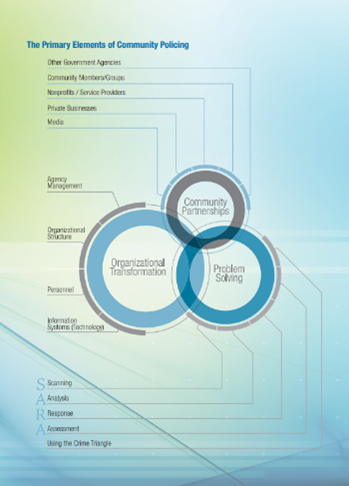
| Why should community policing be clearly defined and understood? -- Here are just a few reasons: |
|---|
| Protection for youth and vulnerable populations. |
| Protection for officers against reputational risk. |
| Added protection for agencies concerning liability. |
| Protection for the braoder profession from erosion of confidence |
In small and rural communities, the need for visible boundary clarity is heightened rather than diminished. Personal familiarity between officers and residents can foster cooperation, but it can also blur roles. When social and professional spaces overlap, leadership responsibility increases. Clear policies, consistent supervision, and thoughtful guidance regarding public interactions help ensure that engagement supports safety objectives rather than undermining them.
Why the Hype?
Nationally, controversies have surfaced when informal or highly visible officer conduct has raised questions about professional boundaries rather than criminal wrongdoing; particularly involving social media or youth interactions. In most documented cases, departments initiated internal reviews focused on policy compliance, safeguarding protocols, and conduct standards. While criminal charges are rare absent exploitation or abuse of authority, agencies have frequently issued discipline, clarified social media policies, or strengthened youth engagement guidelines after public scrutiny.
The consistent national pattern is not that engagement is improper, but that unstructured or poorly contextualized interactions can generate reputational risk and prompt calls for clearer policy alignment. Below are several recent occurrences uncovered during a brief search:
While most of the reports in the news clips above are within the last year or so, a January 2022 Report to Congress entitled Law Enforcement and Technology: Using Social Media by Kristin Finklea, a specialist in domestic security, emphasizes that social media is one of many tools law enforcement can use as an investigative tool, but also to connect with the community. Even so, a White House Task Force on 21st Century Policing and the DOJ "recommended that law enforcement agencies develop policies governing the use of social media." In short, this means agencies should define when and how use of social media is permitted, especially when on duty, using government equipment, or representing an agency. A weak, or lacking, policy has far-reaching implications. For example, bypassing policy can result in the government withholding of grant funding. "Programs such as the Edward Byrne Memorial Justice Assistance Grant (JAG) program and the Community Oriented Policing Services (COPS) program have been used to incentivize activities of state and local enforcement and may be leveraged to influence the adoption of social media policies" (CRS. 2022).
Many organized departments post their public policies online. In fact, the Department of Justice COPS Office (DOJ COPS) has issued multiple resources on social media use by police including:
Model Social Media Policy Templates
Best Practices Guides
Training Materials
The International Association of Chiefs of Police (IACP), one of the largest professional organizations in law enforcement leaders worldwide, provides model policies on social media that many U.S. departments reference. Their policy templates typically address:
Official department social media account governance
Employee personal use of social media
Supervisory responsibilities for monitoring compliance
Rules about representing or commenting about the agency
Training and disciplinary procedures for violations
Other Professional Standards and Bodies available:
Commission on Accreditation for Law Enforcement Agencies (CALEA) - Accreditation standards frequently require documented policies on communications, including social media.
Police Executive Research Forum (PERF) - Offers analytic reports on social media use and public trust.

When community policing works well, it looks structured and purposeful. It includes supervised mentoring programs, collaborative problem-solving efforts that reduce repeat calls for service, and transparent communication between agencies and residents. It ties relationship-building directly to measurable improvements in safety and trust.
Reducing community policing to symbolic visibility or informal interaction oversimplifies a concept that was designed to strengthen democratic governance in public safety. If the term is stretched to include any form of social engagement, its professional meaning becomes diluted. Over time, that dilution can create confusion about standards and expectations.
This conversation is not about criticism for its own sake. It is about stewardship. Emergency response and public safety depend on voluntary cooperation. Citizens must feel confident that authority is exercised responsibly and consistently. That confidence is built through professionalism as much as approachability.
Clarifying what community policing is — and what it is not — helps preserve that confidence.
Engagement remains valuable, but it is most effective when guided by clear purpose, ethical boundaries, and alignment with safety objectives. In small communities especially, where relationships are close and visibility is constant, that clarity supports both officers and the public they serve.
-Tomas Karedin, Policy Analyst
On Public Scrutiny and Civil Discourse
The recent social media post that initiated this broader conversation did not generate the substantive dialogue it was intended to prompt. The objective was to ask questions prompted by the clip, and to encourage discussion about resource stewardship, policy, and principles underlying community policing. Instead, much of the reaction was centered on whether the actions in the video should have been questioned by the public (at large) at all. Individuals close to the officers involved expressed strong disagreement with SPA raising questions on behalf of the numerous community members who provided the clip along with comments and questions. Those responses were not suppressed by SPA.
What was moderated were comments that became disrespectful toward a particular officer—who SPA intentionally chose not to disclose—and toward the department as a whole. Our intent was not to target individuals, but to examine standards. In the absence of full context, the clip was interpreted by many as entirely negative, offensive, unbecoming, or not well thought out, while others dismissed any concern outright. Meanwhile, the more substantive questions raised in the post were largely left unanswered in the public thread.
At last check, the SPA post has reached nearly 12,000 views and generated 165 direct contacts to SPA before comments were ultimately closed, with additional messages continuing to trickle in. Many of those communications reflected concerns that individuals were not comfortable expressing publicly. Those voices matter, even when they are not visible on social media.
SPA does not apologize for sharing the video, asking questions, or shutting down irrelevant, disrespectful comments. Public institutions operate within a constitutional framework that protects free expression, including scrutiny of government authority. At the same time, free expression does not require this platform to host hostility toward law enforcement or personal attacks. Respectful dialogue will always be permitted here—even when it is respectfully critical of SPA. What will not be permitted is commentary that targets individuals in ways that undermine civil discourse.
The purpose of raising these issues was not to inflame division, nor to contribute to broader national hostility toward law enforcement. It was to encourage clarity about professional standards in a rural community where trust is both deeply personal and operationally essential. Asking questions about governance, boundaries, and accountability is not anti-law enforcement. It is part of maintaining the legitimacy that the community practice and community of policing depend upon.
-SPA Editorial Committee
Editorial Note
A more detailed scholarly analysis of this topic appears in the upcoming Spring 2026 issue of Resilience and Response Review Digital Journal, under the title “Community Policing Misunderstood: Defining Boundaries.”