Editoral: Questions Emerge Over "Official" Pages and Social Media

Published on 15 April 2026 at 17:39

Written by Tomas Karedin 

Earlier today, a question surfaced about whether individuals can be blocked from what appears to be an official, public-facing Facebook page associated with the Pulaski County Detention Center. 

While the origin of the topic centered around the local, county jail, the question presented expands to all levels of government and the broader issue is certainly relevant to those using social media as a public official.

The short answer to can they is - it depends


Disclaimer: No independent verification that individuals being blocked from public pages has taken place by the editor or SPA.  Information presented here was publicly available at the time the article was published. The jail can obviously confirm or deny the statements made publicly regarding their social media account. 


At issue is not simply access to a social media platform—but whether a government-operated page can restrict a citizen’s ability to view or engage with publicly shared information. 

Below are a couple of screenshots of what sparked the recent community discussion.

The first image says, ... "From my understanding nobody should be blocked from a PUBLIC Facebook page when an elected official is involved." 

The second image shows the cover and details for the Pulaski County Detention Center's Facebook page. The jail clearly reserves the right to remove negative content. However, the stated purpose of the page is to "update the public" and it is listed as a government organization. 
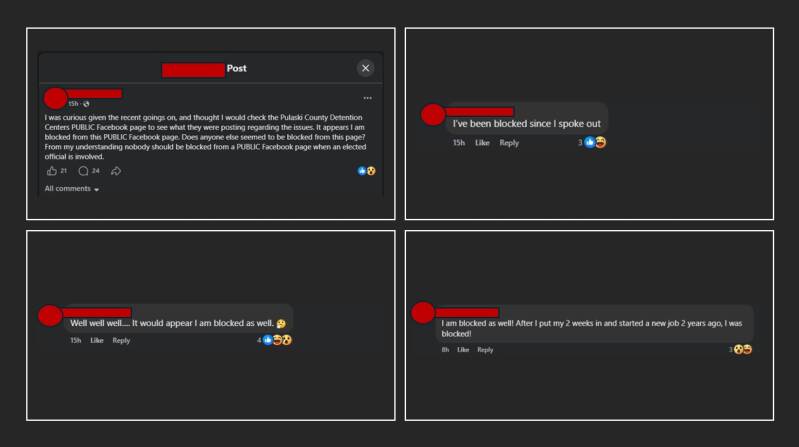
Image above: Public Facebook post and comments captured on April 15, 2026. Even though the post and comments were public, names and images were redacted for the purpose of this article.
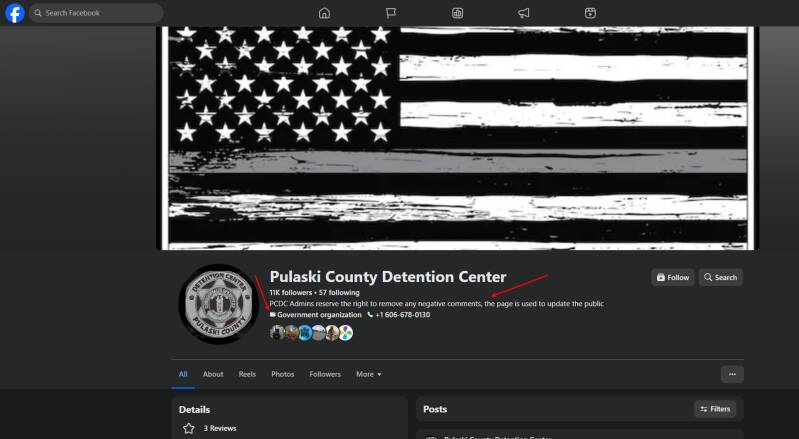
Image above: Screenshot of the Public Facebook Page of the Pulaski County Detention Center depicting that it is a government organization, and that it has the right to remove negative comments. However, it is specifically stated that the page is specifically used to update the public.


Given this topic, here are our questions: 

  • If a page exists to “update the public,” who exactly is included in that definition—and who decides?

  • Can a government agency define “the public” in a way that excludes certain voices?

  • At what point does moderating “negative content” become restricting public participation? Being blocked from the page? Is there a public policy stating this somewhere? 

  • And if access is limited, is that decision based on behavior—or viewpoint? Again, is there a policy somewhere?


It seems the courts are clearly answering at least some of these questions. When a government agency or official uses social media as a tool for public communication, that space may be treated as a public forum under the First Amendment to the United States Constitution. In those cases, restricting access based on viewpoint—such as criticism or disagreement—can raise constitutional concerns.

Courts across multiple jurisdictions have reinforced this principle. In, Davison v. Randall, a federal appellate court held that a local government official’s Facebook page functioned as a public forum, and that blocking a citizen based on their views violated the First Amendment. Similarly, in Knight Institute v. Trump, a federal court found that excluding users from an official social media account due to criticism was inconsistent with constitutional protections, underscoring that digital spaces used for governance are not exempt from free speech principles.

More recently, the U.S. Supreme Court clarified the broader framework in Lindke v. Freed, emphasizing that First Amendment limits apply when public officials use social media to carry out official responsibilities. At the same time, courts have also recognized boundaries. In Campbell v. Reisch, the court found that when an account is purely personal and not used in an official capacity, those constitutional constraints may not apply.

These cases reflect a consistent pattern, which is that when a social media page is used to communicate official information to the public, it carries with it constitutional obligations.

While government entities may enforce reasonable, content-neutral rules related to behavior—such as prohibiting threats or spam—they generally cannot exclude individuals simply for expressing criticism or dissent, when the page is used as an official public forum.

It is also worth noting that courts have drawn important distinctions between personal and official use of social media. As outlined in cases such as Lindke v. Freed and Campbell v. Reisch, what may begin as personal communication can take on official status depending on how the platform is used. Public officials—elected or not—should be aware of where that line is drawn.

Author's note: This is only my interpretation of the situation based on the readily available evidence presented: the original publicly available post, the jail's social media page, the cases I was able to locate upon searching, and my understanding after reading through those cases. I personally do not know the original poster, commenters, or the administrator of the public social media page. Furthermore, I do not know the historical connections between the parties involved and I do not have first-hand knowledge that any of these people were, in fact, blocked. However, I am willing to take the original post and comments at face value for the sake of researching the topic.

If you have a differing view, more information, or believe any of this has been misinterpreted, please let us know!