By SPA Staff Research Team
For years, the intersection at KY 914 and Slate Branch Road in Somerset operated in a familiar way. A traffic signal controlled movement. Drivers stopped, waited, and moved through the intersection with predictable patterns.
That changed in May 2024.
According to the Kentucky Transportation Cabinet (KYTC), the signal became inoperative and temporary traffic controls were put in place.¹ Stop signs were installed on Slate Branch Road. Turning movements were restricted. Barriers were added to manage traffic flow. At the time, those measures were presented as temporary—an interim response to a maintenance issue.
But the signal was never restored.
Instead, the temporary configuration remained in place for an extended period. What initially appeared to be a repair delay ultimately became something else. In April 2026, KYTC formally announced a Highway Safety Improvement Program (HSIP) project to redesign the intersection.² The plan replaces the signalized intersection with a Reduced Conflict U-Turn (RCUT) design.
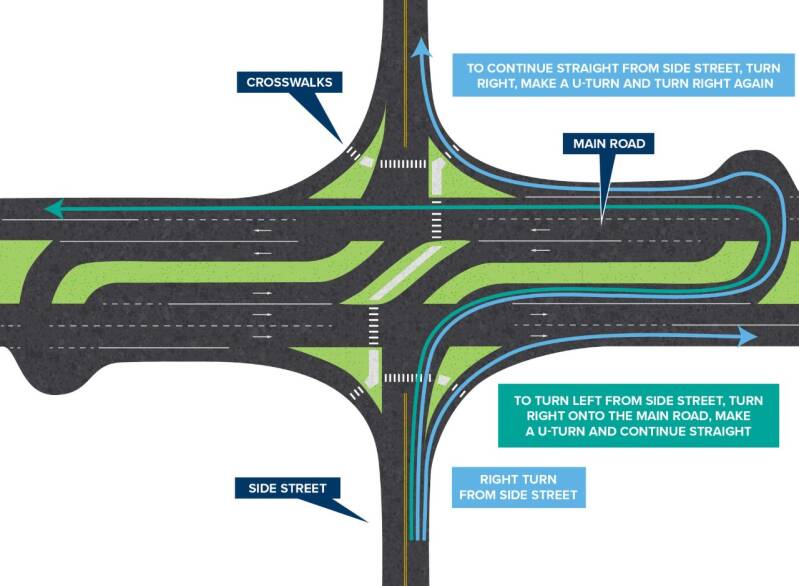
Image provided by the Kentucky Transportation Cabinet District 8
Under that design, drivers on Slate Branch Road can no longer proceed straight or turn left onto KY 914. They must turn right, continue to a designated median opening, and make a U-turn to travel in the opposite direction.
This type of design is part of a broader shift in roadway engineering. The Federal Highway Administration promotes reduced-conflict intersections as a way to lower crash severity by eliminating direct crossing movements.³ Research compiled in the Transportation Research Board Highway Safety Manual and design guidance from the American Association of State Highway and Transportation Officials support this approach, emphasizing fewer conflict points and improved traffic flow.⁴
From an engineering standpoint, the rationale is established. From a community standpoint, the experience is different. The intersection no longer functions as it did for years. Travel patterns have changed. Routes are less direct. What began as a temporary disruption has become a permanent redesign.
That distinction matters.
It also raises a broader question about accountability when roadway design changes affect public use. A recent ruling from the Supreme Court of Kentucky clarifies how those questions may be addressed. In HMB Professional Engineers, Inc. v. Ives, the Court held that negligence claims involving roadway design can proceed in Kentucky courts, even when federal standards are involved.⁵
In practical terms, adherence to national design guidance does not automatically shield a roadway configuration from legal scrutiny. If a design is alleged to create unsafe conditions, that claim can be examined on its merits.
The situation at KY 914 and Slate Branch Road illustrates how these issues intersect. What began as a signal failure evolved into a redesign aligned with national safety guidance. At the same time, the transition from temporary controls to permanent change occurred over an extended period, with the functional reality of the intersection shifting before the final design was formally implemented.
Public infrastructure decisions often involve tradeoffs between efficiency, safety, and usability. Engineering standards provide a framework for those decisions. Agencies implement them. Communities live with the results.
When a traffic signal fails, the expectation is repair. When it is replaced with a fundamentally different traffic pattern, the issue is no longer maintenance—it is design.
And when design decisions change how a community moves, the question of accountability does not disappear. It becomes more important.
With the Kentucky Transportation Cabinet announcing that construction is set to begin this week, the immediate question is no longer what is planned—but what, if anything, the public can still do.
Residents are also asking a related question: Was there supposed to be a public comment period—and if so, did it occur?
For projects of this type, is a formal public hearing always required, particularly when classified as safety improvement under federal guidelines?
Even so, the level of public engagement leading up to the decision remains an open question for many in the community.
Some residents have already begun voicing concerns publicly, including on the KYTC District 8 social media announcement. One commenter encouraged others to contact the agency directly to express opposition. That kind of engagement may still matter—particularly when it is focused and informed.
At this stage, one of the most constructive steps the public can take is to seek clarity on how the decision was made. Key questions include:
-
What traffic studies or crash data were used to justify the design?
-
How was the project classified, including any documentation under the National Environmental Policy Act (NEPA)?
-
What was the formal project justification?
-
What design alternatives were considered—and why were they rejected?
-
What, if any, public input was gathered during the process?
-
What does the internal timeline show about when the shift from temporary controls to permanent redesign occurred?
These questions go directly to how public infrastructure decisions are made and communicated. Requests for this information can be made through the Kentucky Open Records Act, which allows citizens to access government records related to public business.
In addition, residents who have concerns can still engage elected officials at both the local and state level. While halting a project after a contract has been awarded is unlikely, public pressure can sometimes influence implementation details, mitigation measures, or future decision-making.
The reality is straightforward. Stopping the project at this point is unlikely—but not entirely impossible. What remains possible is greater transparency, clearer justification, and a more informed public understanding of how this decision was reached.
Footnotes
- Kentucky Transportation Cabinet, “Emergency Signal Repairs and Temporary Traffic Control Measures at KY 914 and Slate Branch Road,” District 8 Public Notice, May 2024.
- Kentucky Transportation Cabinet, “KY 914 / Slate Branch Road Intersection Safety Improvements (HSIP Project Announcement),” District 8 Release, April 2026.
- Federal Highway Administration, Reduced Conflict Intersections Informational Guide (Washington, DC: U.S. Department of Transportation, 2014).
- Transportation Research Board, Highway Safety Manual (Washington, DC: National Academies Press, 2010); American Association of State Highway and Transportation Officials, A Policy on Geometric Design of Highways and Streets, 7th ed. (Washington, DC: AASHTO, 2018).
- HMB Professional Engineers, Inc. v. Ives, Nos. 2024-SC-0284-DG et al. (Ky. Apr. 23, 2026).
SPA is a volunteer-led initiative. We are not funded by any candidate, campaign, or outside entity and do not endorse political candidates. Content is based on publicly available records and analysis for informational purposes.