By Thomas Karedin, Contributor | Somerset-Pulaski Advocate
Now It's Not IF, but When.
After speaking with individuals who attended Tuesday's Chamber of Commerce luncheon, along with reviewing subsequent coverage of the event, we came away with a different question than the one we started with.
The question is no longer whether data centers are a possibility in Kentucky or even if they will locate near Pulaski County. They will.
The question is not whether utility providers are preparing for them. It is confirmed. They are.
The question is not even whether communities will continue to be approached by developers. They will.
The real question is whether citizens will have a meaningful opportunity to participate in the conversation before important decisions have already been made, and whether the public will be informed before those decisions effectively become a foregone conclusion.

Image by makaule | Adobe Stock
East Kentucky Power Cooperative CEO Don Mosier told local business leaders in Somerset and Pulaski this week that data center development is increasingly unavoidable and that Kentucky is better positioned to manage the impacts itself rather than leaving those decisions to neighboring states.¹
Those remarks are consistent with positions Mosier has expressed previously. In a March 2026 column published in Kentucky Living, he wrote, "Data centers are coming, and East Kentucky Power Cooperative (EKPC) is ready." He further explained that "under Kentucky law, cooperatives must provide service to any home or business that chooses to locate in their service territories," making preparation not simply a business decision, but a legal necessity.²
Those comments should not alarm citizens. They should, however, serve as a reminder that the questions many residents have been asking were neither unreasonable nor uninformed. When local citizens raised concerns after seeing land marketed as "AI Data Center Ready," some were told they were worrying about a "phantom data center." Yet the discussion this week made clear that data center development is not a fictional issue, nor is it confined to distant communities. It is a real and growing topic across Kentucky, one that utilities, developers, elected officials, and citizens alike are increasingly being forced to confront.
As data center development continues to expand across the Commonwealth, the question is no longer whether communities should be asking questions. The question is whether they will have the opportunity to ask them before important decisions are already underway.
That concern is not hypothetical.
Communities in Boyd County, Mason County, Mercer County, and elsewhere have already expressed frustration that major discussions occurred before the public knew they were happening.³ In Boyd County, residents openly challenged local officials over non-disclosure agreements that prevented details from being shared while negotiations were underway.⁴
No evidence has emerged that laws were broken. But many citizens are left with the feeling that they were hearing about projects only after significant progress had already been made.
Kentucky's Open Meetings Act declares that the formation of public policy is public business and should not be conducted in secret.⁵ Yet Kentucky law does not prohibit local governments from entering confidentiality agreements during preliminary economic development discussions.⁶ From what we can tell, non-disclosure agreements (NDAs) between developers and local governments are generally legal under Kentucky law. During preliminary economic development discussions, such agreements may limit what officials can publicly disclose about a proposed project. As a result, there can be a significant period between when discussions begin and when the public becomes aware that they are taking place. In other words, we may only know when developers break ground.
For hot topic issues like data centers, this sort of business strategy is not necessarily an approach that garners public trust for officials. In fact, it plays to the opposite.
Public officials may sincerely oppose a particular project or development today. Yet citizens also understand that circumstances, priorities, and opportunities can change over time. As a result, public confidence often depends less on assurances about what will or will not happen and more on whether discussions are occurring openly and transparently. In that regard, East Kentucky Power Cooperative CEO Don Mosier's message has remained notably consistent. For months, he has publicly maintained that data centers are coming to Kentucky and that utilities must prepare for that reality. Whether citizens ultimately support or oppose such development, meaningful participation requires that the conversation occur with all the relevant information on the table.
At this point, whether one supports data centers or opposes them is almost beside the point.
The questions many citizens are asking are far more practical:
-
At what point should the public be informed?
-
What discussions may already be occurring behind the scenes?
-
How far can landowners and developers go before local officials, planning commissions, state agencies, or utility regulators become involved?
-
What legal authority do local governments actually have to stop, delay, or influence a project once negotiations, agreements, or regulatory processes are underway?
These are not unreasonable questions. They are the same questions being asked in communities across Kentucky. and other parts of the nation.
Trust in government ultimately depends not only on the integrity of elected officials, but also on the transparency of the process itself. Citizens should not have to wait until a project is announced to begin asking questions about infrastructure, water, electrical demand, land use, incentives, or long-term community impacts. Public participation is most meaningful before decisions are effectively made. Not after.
Which brings us back to our biggest question, which is not whether we are preparing for them, it is whether citizens will be told or have an opportunity to participate in the conversation before the decisions have already been made.
Based on the experiences of communities elsewhere in Kentucky, that answer appears increasingly uncertain. And that uncertainty may be exactly why so many people are asking questions now.
Today's Projects. Tomorrow's Possibilities.
As the map demonstrates, significant portions of Kentucky are occupied by national forests, military installations, national parks, recreation areas, wildlife refuges, reservoirs, and other protected federal lands where large-scale private industrial development is generally restricted or prohibited. As a result, future data center development is more likely to occur in areas with available private land, existing industrial infrastructure, transmission capacity, water resources, and access to major transportation corridors.
While no map can predict where future projects will ultimately be located, it helps illustrate why certain regions of Kentucky continue to attract attention from developers while others remain largely unavailable for such development.
Click to enlarge the map
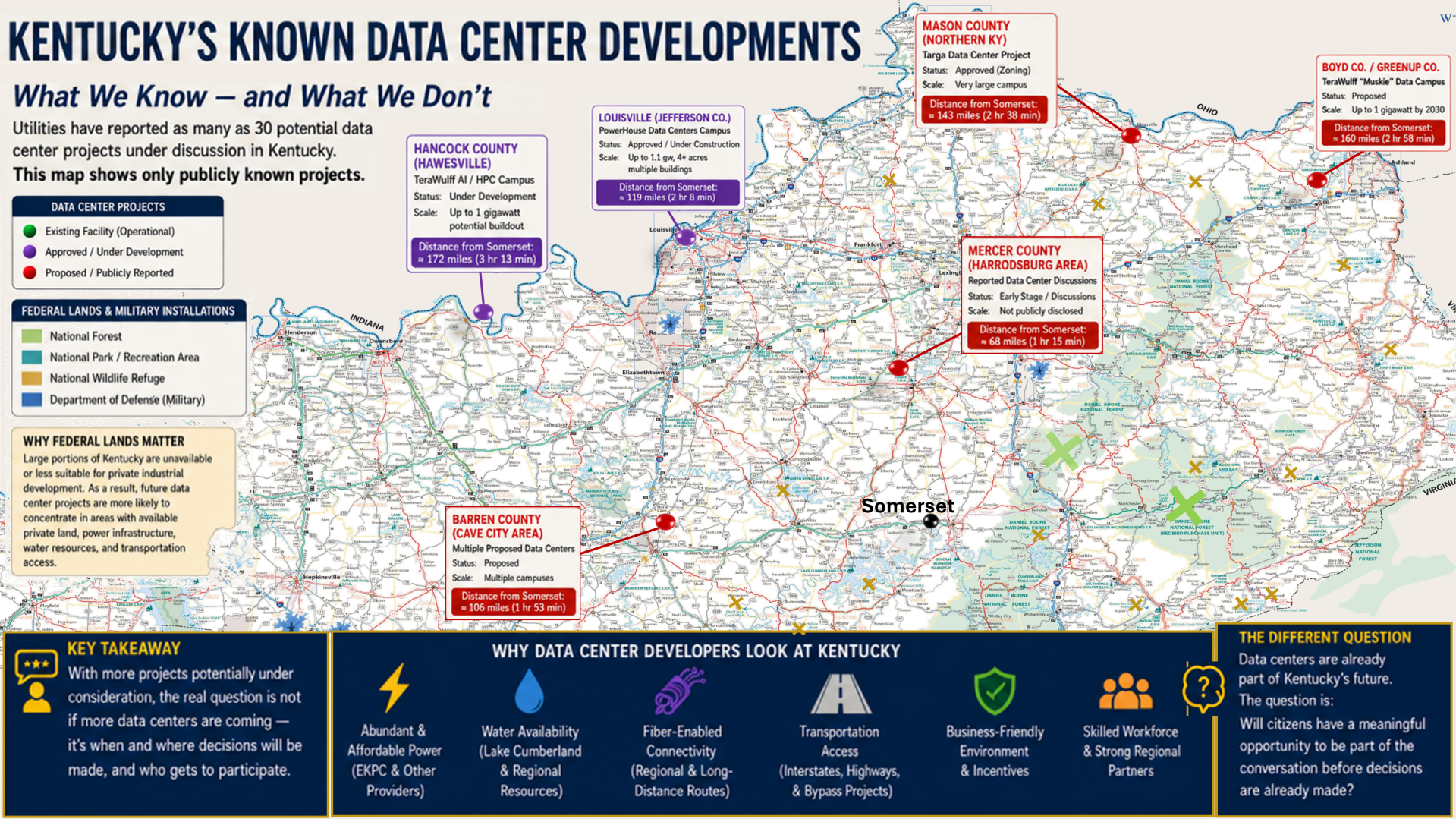
Map intended for informational purposes. Locations and project status are based on publicly reported information as of May2026. Additional projects may exist that have not been publicly disclosed.
Image by SPA | Revised by ChatGPT | All rights reserved.
Footnotes
- Christopher Harris, "EKPC CEO Talks Data Center Concerns, Plant Upgrades with Chamber Crowd," Commonwealth Journal, June 4, 2026.
- Don Mosier, "Data Centers Will Come to Kentucky; EKPC Is Prepared," Kentucky Living, March 13, 2026.
- Liam Niemeyer, "Utilities Report as Many as 30 Data Centers under Discussion across Kentucky," Kentucky Lantern, June 1, 2026; Liam Niemeyer, "Starting it off shady: Residents question NDAs, protections for proposed Boyd Co. data center," Kentucky Lantern, June 2, 2026.
- Niemeyer, "Starting it off shady."
- Ky. Rev. Stat. Ann. § 61.800 (West 2025).
- Kentucky law does not appear to prohibit public agencies from entering confidentiality or non-disclosure agreements during preliminary economic development discussions, although such agencies remain subject to the Kentucky Open Records Act and Kentucky Open Meetings Act. See Ky. Rev. Stat. Ann. §§ 61.800–61.850; 61.870–61.884.
Additional Sources
Questions Grow About Who Will Pay the Cost for Big Data Centers in Kentucky | By Patience Martin | KyPolicy
Kentucky must make data centers pay their own way | By Roger Ford and Erin Petrey | Featured in the Hazard Herald
Utilities report as many as 30 data centers under discussion across Kentucky | By Liam Niemeyer | Featured in the Kentucky Lantern