By Michael R. Grigsby, Editor | Somerset-Pulaski Advocate
Beyond the Watchful Eye: Reconceptualizing Academic Integrity and Honor Codes in the Era of Generative Artificial Intelligence

Image: Adobe Stock | The Little Hut © 2026 All Rights Reserved.
Somerset, KY (SPA)---- OPINION The traditional collegiate honor code, developed in the early 20th century, is based on shared trust, peer accountability, and social agreements (Bertram Gallant, as cited in Inside Higher Ed, 2026). These codes shifted the responsibility of maintaining academic honesty from faculty to students, fostering mutual respect. Now, the widespread adoption of generative artificial intelligence (GenAI) such as ChatGPT, Claude, and Gemini challenges and destabilizes these foundations by introducing new forms of academic misconduct that the existing honor code structure cannot address.
As universities like Stanford and Princeton end unproctored exams due to AI-driven cheating, higher education reaches a crucial turning point. Traditional honor codes, designed to prevent plagiarism and unauthorized human collaboration, are not prepared to address dishonest interactions with AI systems. In this paper, I argue that honor codes cannot effectively control the use of GenAI and that both increased surveillance and reliance on AI detection tools have significant shortcomings. I propose that academic integrity must instead shift toward transparency in AI use and authentic assessments that focus on the learning process, not just final products.
The Anomie of the Digital Solitary: Why Honor Codes Fail Against AI
Traditional honor codes depend on social deterrence and the emotional cost of breaking a group pact. Cheating by copying from a peer or buying a paper constitutes a clear breach of interpersonal ethics and threatens the student's community status. Using GenAI is solitary, easy, and private. Alone in a dorm, a student using an AI chatbot feels less internal conflict when cheating. Every day, tools blur the lines between legitimate help and dishonesty.
In addition, the nature of academic cheating has evolved with the rise of AI. Students now often engage in 'cognitive outsourcing,' seeing GenAI not as a means of cheating but as necessary for academic success (Torres, as cited in Inside Higher Ed, 2026). A 2025 survey found that 85% of students used GenAI for tasks such as brainstorming, editing, and writing full essays. Because students provide prompts and revise AI outputs, many believe they authored the work, blurring the lines between their own input and the AI’s contribution. As cheating shifts from copying to iterative prompting, traditional concepts of plagiarism and honesty become unclear and outdated.

Image by Author, M. Grigsby (C) 2026 All Rights Reserved.
The Fallacy of Detection and the Limits of Surveillance
Many institutions have increased surveillance in response to AI-enabled cheating. Elite universities returning to proctored exams reveal this trend. Proctoring secures only some assessments and does not address take-home assignments, research papers, or continuous assessments.
Simultaneously, reliance on technological solutions, such as AI detection software, has proven to be an academic and administrative failure. Empirical research has repeatedly shown that AI detectors exhibit unacceptably high rates of false positives and false negatives, frequently misidentifying the work of non-native English speakers as machine-generated (Liang et al., 2023). Recognizing these flaws, progressive student honor committees, such as the one at the University of Virginia, have banned the admission of AI detection tools in integrity hearings, opting instead for holistic syntax and contextual analyses (Freed, as cited in Inside Higher Ed, 2026).
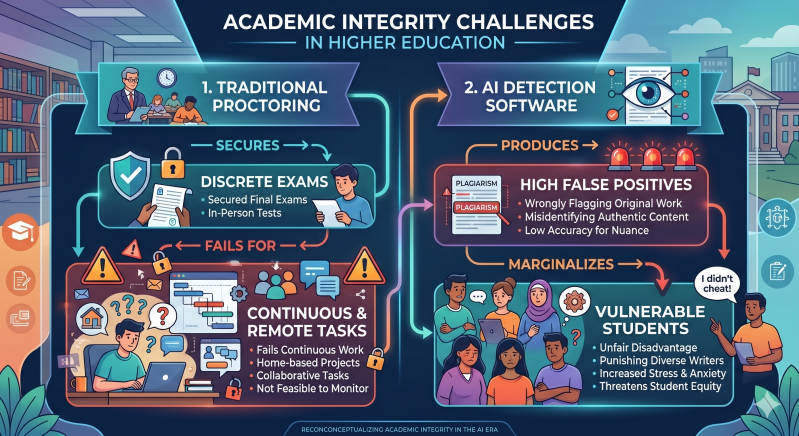
Figure 1: The Structural Limitations of Reactive Academic Integrity Measures. (C) 2026 M. Grigsby All Rights Reserved
When schools rely on surveillance and flawed AI detection, the academic environment changes. The faculty-student dynamic shifts from collaboration to distrust, undermining the culture of mutual respect that honor codes were meant to foster. Trust is replaced by suspicion.
Reconceptualizing the Honor Code: From Compliance to Process-Oriented Integrity
If honor codes are to survive the AI age, they must be radically reformed rather than abandoned. This reform requires shifting the focus of academic integrity frameworks from product-oriented compliance (the final artifact) to process-oriented accountability (the learning methodology).
Honor codes should no longer list prohibitions. In the GenAI era, they must define what counts as proper human-AI collaboration. Because standards differ by field and task, blanket bans fail. Institutions should require full transparency. Students should document and cite their AI use and describe how they built prompts, evaluated outputs, and achieved synthesis.
Pedagogical Evolution: Authentic Assessment as the Ultimate Deterrent
Honor code changes will fail if universities use outdated assessments. If AI can complete an assignment, that task is no longer valuable in 2026. Authentic assessment is the solution.
Employers no longer judge by recall or isolated writing. They value skill in handling real data, ethical use of technology, and creative problem-solving (Torres, as cited in Inside Higher Ed, 2026). Higher education must adapt to match this reality.
Restructuring curricula around authentic assessment reduces incentives for academic dishonesty. If the focus shifts to evaluating the learning process itself, the temptation to misuse AI declines, and students benefit from more engaging, transparent, and individualized education. Honor codes can persist in the AI era, but only if they move away from policing and evolve into agreements promoting critical thinking, creativity, and ethical responsibility.
References
- Inside Higher Ed. (2026). Can—and should—honor codes survive in the AI age? [In-text data and interview transcripts provided by user].
- Liang, W., Yuksekgonul, M., Zou, J., & Zou, J. (2023). GPT detectors are biased against non-native English writers. Patterns, 4(7), 100779. https://doi.org/10.1016/j.patter.2023.100779
*******
(C) 2026 Somerset-Pulaski Advocate. All Rights Reserved
Add comment
Comments